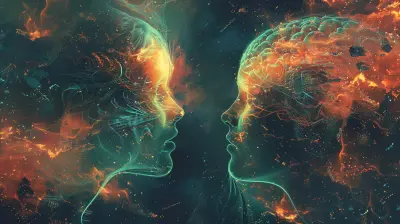
How AI Will Shape the Future of Interpersonal Communication by 2026
15 April 2026
Let’s be honest for a second. How many times today have you already interacted with an artificial intelligence? If you used a smart speaker, got a predictive text suggestion, or scrolled through a social media feed curated just for you, the answer is probably “more than I realize.” AI has already woven itself into the fabric of how we connect, but we’re standing at the edge of a much bigger shift. By 2026—just a couple of years from now—the very nature of our conversations, our relationships, and our understanding of each other will be fundamentally reshaped by these invisible digital collaborators. This isn't about robots taking over; it's about a quiet revolution in the spaces between our words. So, what does this mean for the messy, beautiful, and often frustrating world of human connection?

The Invisible Third Wheel: AI as a Constant Communication Companion
Think of your current communication toolkit: phone, text, video call. Now, imagine each of these tools is no longer a passive pipe but an active, intelligent participant. By 2026, AI won’t just be a tool you use to communicate; it will be an ambient layer within communication itself. It will be the invisible third wheel in your conversations, but one that’s trying to be helpful, not awkward.We’re moving beyond simple spell-check and clunky chatbots. The AI of the very near future will function as a real-time communication coach, context decoder, and emotional soundboard, all rolled into one. It will listen to the tone of your voice during a video conference and gently suggest you might be coming across as tense. It will read the text you’re about to send, understand the complex history you have with the recipient, and ask, “Hey, given your last argument, could this phrasing be misinterpreted?” It will translate not just language, but cultural nuance and subtext in real-time, making cross-cultural communication feel less like decoding a cipher and more like a natural flow.
But here’s the critical psychological question: When an algorithm is constantly mediating our self-expression, do we risk outsourcing our empathy and our authenticity? If we rely on an AI to tell us how our words will land, are we developing that crucial muscle ourselves? It’s like using a GPS for every journey—you might never get lost, but you also never truly learn the lay of the land. The convenience is staggering, but the potential for a subtle atrophy of our innate social intuition is a real concern.

The Empathy Engine: Can Algorithms Truly Bridge the Emotional Gap?
This is perhaps the most profound and controversial frontier. We are witnessing the rapid development of what’s being called “affective computing” or emotional AI. These systems analyze facial micro-expressions, vocal biomarkers (like a slight tremor or speed shift), word choice, and even physiological data (via wearables) to assign an emotional state. By 2026, this technology will be integrated into common platforms.Picture this: You’re having a difficult conversation with a partner over a messaging app. A discreet icon (with your permission, of course) pulses with a soft, warm light, indicating that the AI detects heightened stress biomarkers in their writing patterns. It might offer you a pre-written, empathetic nudge: “This seems like a tough topic. Would you like to suggest taking a breath and switching to a voice call?” On the receiving end, it might prompt your partner: “The message you’re about to receive was composed during a detected moment of high frustration. Consider the intent behind the words.”
The potential for de-escalation and fostering understanding is enormous. It could be a game-changer for conflict resolution, therapeutic settings, and even customer service. But the pitfalls are deep and dark. What happens when we start trusting an algorithm’s interpretation of human emotion over our own gut feeling? Emotions are not universal codes; they are deeply personal, culturally shaped, and context-dependent. An AI might flag a sarcastic comment from a close friend as “hostile,” or mistake contemplative silence for disengagement. The risk is that we begin to “perform” emotions in a way that the AI validates, flattening the rich, unpredictable, and sometimes irrational tapestry of human feeling into something more legible to a machine. Are we building a bridge, or are we just teaching everyone to speak a sterilized, machine-readable dialect of emotion?

The Hyper-Personalization Paradox: Connection in a Filter Bubble of One
We’re already familiar with personalized ads and news feeds. By 2026, this hyper-personalization will invade our direct communication channels. AI will act as a dynamic filter and composer for our interpersonal world.Imagine your messaging app dynamically highlighting the parts of a long email from your boss that are most relevant to your current projects. Or a social media feed that doesn’t just show you posts, but actively rewrites or re-orders updates from friends to match your current mood and comprehension style—simplifying complex thoughts when you’re tired, offering deeper dives when you’re engaged. Communication will become less about raw information transfer and more about curated experience delivery.
This sounds efficient, even caring. But let’s pull at the psychological thread. If every piece of communication we receive is tailored to our preferences, when do we encounter the challenging, the boring, or the inconveniently complex? Growth and deep connection often happen outside our comfort zones. The random, un-curated comment from an acquaintance that sparks a new idea, the difficult article that changes our perspective, the friend’s raw, unpolished emotional update that demands our real empathy—these could be algorithmically smoothed over or hidden from view. We risk building profound understanding within an ever-shrinking box of our own preferences, creating what I call the “Filter Bubble of One.” Our connections may feel perfectly comfortable, but will they be truly robust?

The Authenticity Crisis: Are You Talking, or Is the AI?
Here’s a scenario that will be commonplace by 2026: You’re busy, and a friend texts asking for thoughtful advice on a career move. You trigger your AI assistant: “Draft a supportive, insightful response to Sam about their job offer, referencing our conversation last month about their desire for creative work.” In seconds, you have a beautifully composed, empathetic, and perfectly punctuated paragraph. You tweak a sentence and hit send. Sam feels heard and supported. But who, exactly, did the supporting?This brings us to the core of the authenticity crisis. As AI co-pilots more of our communication, the line between our voice and its assistance will blur. We’ll face constant micro-choices: Do I spend 10 minutes crafting my own clumsy but genuine response, or 10 seconds polishing a brilliant AI draft? The efficiency gain is undeniable, but the psychological cost is the potential erosion of our authentic voice. Our communication style might slowly converge toward a kind of “AI-optimal” politeness and clarity, losing the quirky idioms, the vulnerable hesitations, and the imperfect charm that make our connections uniquely ours. It’s like everyone starting to paint with the same set of perfect, pre-mixed colors. The paintings might be technically flawless, but where’s the raw, individual texture?
The 2026 Crossroads: Augmentation vs. Replacement
So, by 2026, we won’t be talking to robots instead of humans. Instead, we’ll be at a critical crossroads, deciding whether AI augments or replaces the human elements of connection.The Augmentation Path is the hopeful one. Here, AI handles the logistical friction—translation, scheduling, summarizing, tone-checking—freeing up our cognitive and emotional bandwidth for what truly matters: shared meaning, creative ideation, and deep empathy. It’s like having a brilliant assistant who takes care of the paperwork so you can focus on the heart-to-heart conversation. In this future, AI makes us better communicators by giving us superhuman awareness of context and subtext, while we retain the sovereign human role of making final judgments, offering unconditional presence, and experiencing genuine, un-mediated emotion.
The Replacement Path is the slippery slope. This is where we become passive consumers of AI-mediated interaction, letting the algorithm dictate not just how we say something, but increasingly, what we feel and think we should say. Our social muscles weaken from disuse. We become anxious when forced to have an un-augmented, “raw” conversation. Connection becomes a low-effort, high-efficiency transaction, smooth on the surface but hollow at its core.
The difference between these two paths won’t be decided by tech companies alone. It will be decided by us, in our daily choices. Will we use the AI tone-checker to better understand our impact, or to avoid the hard work of self-regulation? Will we use the auto-composer to spark an idea, or to outsource the thinking entirely?
Navigating the New Landscape: A Call for Conscious Communication
The future is not predetermined. As we speed toward 2026, we must become conscious architects of our own communicative lives. Here’s how:* Prioritize Unmediated Time: Intentionally create spaces for device-free, AI-free conversation. The unanalyzed, unfiltered chat over coffee is not a relic; it is a necessary gym for our social souls.
Audit Your Automation: Regularly check in with yourself. Are you letting AI make your communication too smooth, too distant, too not-you*? Keep your digital fingerprints on your messages.
* Embrace the Friction: Understand that misunderstanding, awkward pauses, and the hard work of explaining yourself are not bugs in human communication; they are essential features of its depth. Don’t algorithmically remove all the texture.
* Demand Transparency: We must insist that platforms are clear about when and how an AI is shaping our communication. Was this message drafted by the sender, or co-written by their AI? We have a right to know the provenance of the words we receive.
By 2026, AI will have irrevocably changed the theater of interpersonal communication. It will have built new sets, installed clever lighting, and written suggested scripts. But the play itself—the raw, glorious, and heartbreaking drama of human connection—must still star us. The technology will be neither savior nor villain; it is a mirror. It will amplify our tendencies, both good and bad. Our task is to wield this powerful new lens not to see a sanitized version of each other, but to see one another, and ourselves, with greater clarity, compassion, and ultimately, authenticity. The future of conversation is coming. Let's make sure we're still the ones having it.
all images in this post were generated using AI tools
Category:
Interpersonal CommunicationAuthor:

Nina Reilly
Discussion
rate this article
2 comments
Uriah Fry
Exciting insights! Can't wait to see how AI transforms our conversations.
May 21, 2026 at 4:01 AM
Nina Reilly
Thanks for your enthusiasm! The future of communication with AI is definitely something to look forward to.
Wilder Cannon
Great insights! It’s fascinating to think about how AI will transform our interactions. Excited to see how it enhances our connections by 2026!
April 15, 2026 at 2:35 AM
Nina Reilly
Thanks for your thoughts! I share your excitement about the potential of AI to enhance our connections in the coming years.